
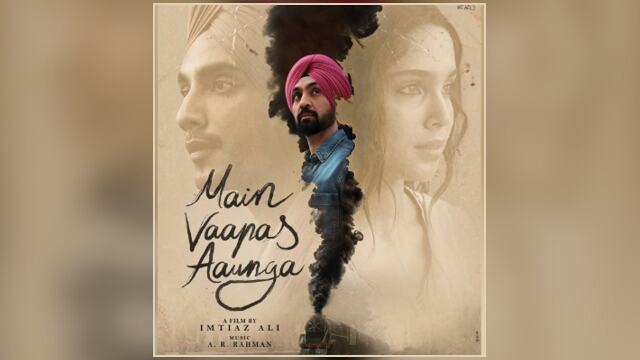
Few directors return to the theme of love across time and memory as consistently as Imtiaz Ali, and Main Vaapas Aaunga might be his most emotionally ambitious take on it yet. Set against the trauma of India’s Partition, this A.R. Rahman-scored drama trades his usual contemporary romances for a sweeping, generational story about a promise that took decades to keep.
Overview
Main Vaapas Aaunga (meaning “I Will Return”) is a 2026 Hindi-language period romantic drama directed by Imtiaz Ali, written by Ali and Nayanika Mahtani. The film follows 95-year-old Ishar Singh Grewal, who shares the story of a childhood romance shattered by the 1947 Partition of India with his grandson — unfolding across two timelines as young love, forced migration, and a lifetime of longing intertwine.
Basic Details
| Details | Info. |
|---|---|
| Genre | Romance, Drama, Period, Historical |
| Runtime | 2 hr 47 min |
| Director | Imtiaz Ali |
| Writers | Imtiaz Ali, Nayanika Mahtani |
| Music | A. R. Rahman |
| Cast | Diljit Dosanjh, Naseeruddin Shah, Vedang Raina, Sharvari Wagh, Manish Chaudhari, Babita Kapoor, Rajat Kapoor |
| Release Date | June 12, 2026 (theatrical) |
| Where to Watch | Netflix (streaming since August 7, 2026) |
| IMDb Ratings | Not yet showing an aggregate score |
Plot Summary
As India and Pakistan inch toward Partition, a young Ishar Singh — known as Keenu, played by Vedang Raina — falls deeply in love with Afsana, also called Jiya, played by Sharvari Wagh. He repeatedly promises her he’ll never leave. But as Partition tears the subcontinent apart, the two are forced into separation, with only Keenu’s vow, “Main vaapas aaunga,” left to hold onto.
Decades later, 95-year-old Ishar Singh, now played by Naseeruddin Shah, remains haunted by the love story he never fully let go of. His grandson Nirvair, played by Diljit Dosanjh, becomes the narrator of the journey, drawing out his grandfather’s memories of migration, longing, and a home left behind. As the past and present intertwine, the film builds toward a reckoning with what was lost — and what, if anything, can still be reclaimed after a lifetime apart.
Why You Should Watch It
- A genuinely moving central performance from Naseeruddin Shah. Critics single him out as the emotional anchor of the film, bringing real weight to a man still carrying an unfinished love story after seventy years.
- A. R. Rahman’s score elevates every frame. His music has been highlighted as one of the film’s most soulful, memorable elements.
- Imtiaz Ali’s signature philosophical touch. Longtime fans of his work will recognize his recurring fascination with love that transcends time, memory, and circumstance, applied here to real historical trauma.
- A rare, empathetic lens on Partition. Rather than treating the era as pure political backdrop, the film approaches it as intensely personal — a choice critics have called especially relevant and necessary given current events.
Fair warning: multiple reviews describe the narrative as uneven and a bit overlong, given its nearly three-hour runtime. If you’re not already drawn to Imtiaz Ali’s slower, more meditative style, the pacing may test your patience. But critics agree that it builds to a deeply moving, bittersweet finale that lingers well after the credits roll — for patient viewers, the payoff is worth it.
Recommendations
If Main Vaapas Aaunga resonated with you, here’s where to go next:
- Rockstar (2011) — Another Imtiaz Ali film exploring love, longing, and emotional transformation, for a sense of his recurring thematic obsessions.
- Jab We Met (2007) — For an earlier, lighter example of Ali’s storytelling style before this more somber, historical turn.
- Gadar: Ek Prem Katha — Another beloved Bollywood romance set against the backdrop of Partition.
- Pinjar (2003) — A more grounded, harrowing look at Partition’s human cost through a woman’s story.
- Veer-Zaara (2004) — For more of the India-Pakistan divided-love genre, spanning decades of longing and separation.
Conclusion
Main Vaapas Aaunga confirms Imtiaz Ali’s gift for turning love stories into meditations on time, memory, and loss — this time applied to one of the most painful chapters in South Asian history. Its length and uneven pacing won’t work for every viewer, but for those willing to sit with its slow-burn emotional build, A. R. Rahman’s score and Naseeruddin Shah’s performance make for a genuinely bittersweet, resonant watch.