
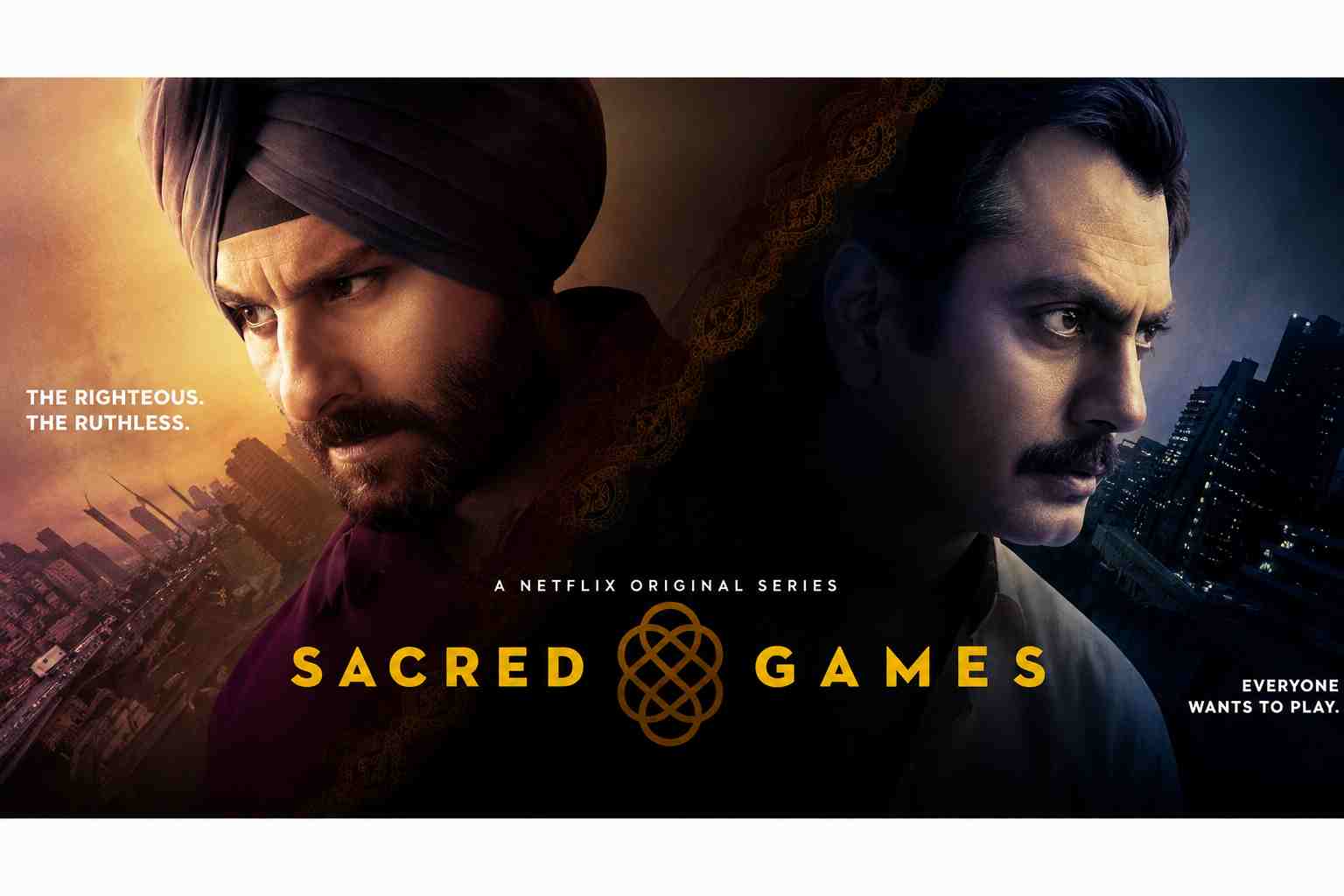
Before Scam 1992, before Mirzapur, before Indian streaming became a genre powerhouse in its own right, there was Sacred Games — Netflix’s first Indian original, and the series that put the platform’s India ambitions on the map. Season 1 remains a genuine landmark; Season 2 is a more divisive follow-up. Together, they form one of the most talked-about crime dramas in Indian television history.
Overview
Sacred Games is an Indian crime thriller series created by Vikramaditya Motwane, based on Vikram Chandra’s 2006 novel of the same name. Starring Saif Ali Khan and Nawazuddin Siddiqui, it follows Sartaj Singh, a disillusioned Mumbai police inspector, and Ganesh Gaitonde, a legendary and elusive gangster who once ruled the city’s underworld — two men whose fates become permanently entangled after a single anonymous phone call.
Basic Details
| Details | Info |
|---|---|
| Genre | Crime, Thriller, Drama, Mystery |
| Seasons | 2 (8 episodes each, 16 total) |
| Runtime | 43–59 minutes per episode |
| Based On | Sacred Games by Vikram Chandra |
| Cast | Saif Ali Khan, Nawazuddin Siddiqui, Radhika Apte, Pankaj Tripathi, Kalki Koechlin, Ranvir Shorey, Elnaaz Norouzi |
| Season 1 Release | July 6, 2018 |
| Season 2 Release | August 15, 2019 |
| Where to Watch | Netflix |
| IMDb Rating | Season 1 episodes average around 8.1–8.9/10; Season 2 episodes average around 7.6–8.2/10 |
| Expected Season | Two seasons released; no Season 3 officially confirmed, despite the ending leaving the door open |
Watch the official trailer below for a first look at Sartaj and Gaitonde’s world before diving into the full review.
Season-Wise Summary
Season 1 (2018): Sartaj Singh, a jaded, corruption-weary Mumbai police inspector, receives an anonymous tip from Ganesh Gaitonde, a legendary gangster who vanished sixteen years earlier. Gaitonde gives Sartaj just 25 days to save Mumbai from an unnamed, impending catastrophe — then takes his own life. As Sartaj investigates, the season unfolds across two parallel timelines: his present-day race to decode Gaitonde’s warning, and Gaitonde’s own decades-long rise from small-time hustler to feared don of the G-Company. The season closes with Sartaj uncovering a cryptic symbol tied to the coming disaster, setting up a far larger threat still to come.
Season 2 (2019): Picking up immediately after Season 1, Sartaj and his team investigate a fallout shelter connected to a looming nuclear threat against Mumbai, tied to a shadowy figure named Shahid Khan and a fictional terrorist network called Hizbuddin. Meanwhile, flashbacks dig deeper into Gaitonde’s past, particularly his relationship with the enigmatic spiritual guru Guruji, whose teachings and obsession with an ancient prophetic text, the Kalgranth, shaped much of Gaitonde’s worldview. The season builds to a tense countdown as Sartaj races to defuse the bomb, ending on a deliberately ambiguous cliffhanger that reveals a startling personal connection between Sartaj and Shahid Khan — and leaves his final choice unresolved.
Why to Watch
- A genuine landmark for Indian streaming. Season 1 is the only Indian series to appear on The New York Times’ list of the 30 best international TV shows of the decade.
- Two towering lead performances. Nawazuddin Siddiqui’s portrayal of Gaitonde and Saif Ali Khan’s world-weary Sartaj are both widely considered among the finest work of their respective careers.
- Pankaj Tripathi’s Guruji is unforgettable. His performance as the unsettling, self-proclaimed spiritual guide became one of the show’s most talked-about elements, especially in Season 2.
- Confident, cinematic direction. With Anurag Kashyap and Vikramaditya Motwane behind the camera, the show brings genuine feature-film craft to a serialized format.
Fair warning: reception between the two seasons diverges sharply. Season 1 earned near-universal critical acclaim, but Season 2 received a more mixed response — some viewers and critics found its pacing slower and its plotting more convoluted, while others appreciated its willingness to deepen the show’s themes around faith, power, and inherited trauma. The Season 2 finale in particular divided audiences with its ambiguous, open-ended conclusion, and no Season 3 has been confirmed to resolve it.
Recommendations
If Sacred Games worked for you, here’s where to go next:
- Scam 1992: The Harshad Mehta Story — Another towering, star-making Indian crime drama, this one grounded in real financial history rather than fiction.
- Mirzapur — For more of Indian streaming’s gritty, power-driven underworld storytelling.
- Asur — A mythology-infused crime thriller for fans who want more genre-blending, philosophically ambitious Indian television.
- My Name — For a tighter, more brutal revenge thriller if you want less mythology and more raw intensity.
- Matka King — Another Mumbai-set period crime saga, for more of that “rise of an empire” storytelling.
Conclusion
Sacred Games remains a defining moment in Indian television history — the show that proved Indian streaming content could compete on a genuinely global stage, anchored by two of the finest lead performances in the medium’s history. Season 1 is close to essential viewing for any fan of crime drama; Season 2 is a more divisive, ambitious swing that doesn’t land as cleanly, but still offers real rewards for viewers willing to sit with its slower burn and unresolved ending.
Frequently Asked Questions
No. It’s based on Vikram Chandra’s 2006 novel of the same name, a work of fiction — though it draws heavily on real Mumbai underworld history and politics for texture and inspiration.
No third season has been officially confirmed as of this writing, despite the Season 2 finale leaving key plot threads unresolved.
16 episodes total across two seasons — 8 episodes each.